
Seeing Patterns in Scenes
Paint rooftops and busy markets
Last week we made patterns for their own sake, repeating a single mark until a cluster of leaves became an artwork. This week we use the same idea to build a whole scene.
Pattern is one of the oldest compositional devices there is. Modern artist Paul Klee treated repetition as the underlying structure of a picture, arranging shapes in rhythms across the canvas, always leaving something out of step to break the pattern.
David Hockney took the same idea outdoors, building his Yorkshire landscapes from repeated trees and hedgerows, teaching the eye to see the pattern in a stretch of countryside we’d normally walk past without a glance.
Give the eye a bunch of similar shapes and it relaxes. It takes in the whole before it inspects any single element. A row of windows, a stand of trees, a harbour full of masts, a hillside of roofs. None of these is particularly interesting on its own, but repeated they something the eye can travel across. The painter’s job is not to draw each element but to organise the group.
The break is where it comes alive. A pattern with no interruption is wallpaper. One element that’s different, a dark roof among the pale ones, a single figure facing the wrong way, and suddenly the whole arrangement has a focal point.
So this week we take two scenes and look at the patterns within them. A hilltop town becomes a cluster of tilted planes. A crowded market becomes rounded baskets, pale triangles and a few figures. The arrangement is the subject, and we don’t need any detail at all.
Exercise
Rooftop Pattern
The reference photos and video demos for both exercises are below in the paid section. If you’re on the free plan, search for similar photos online.
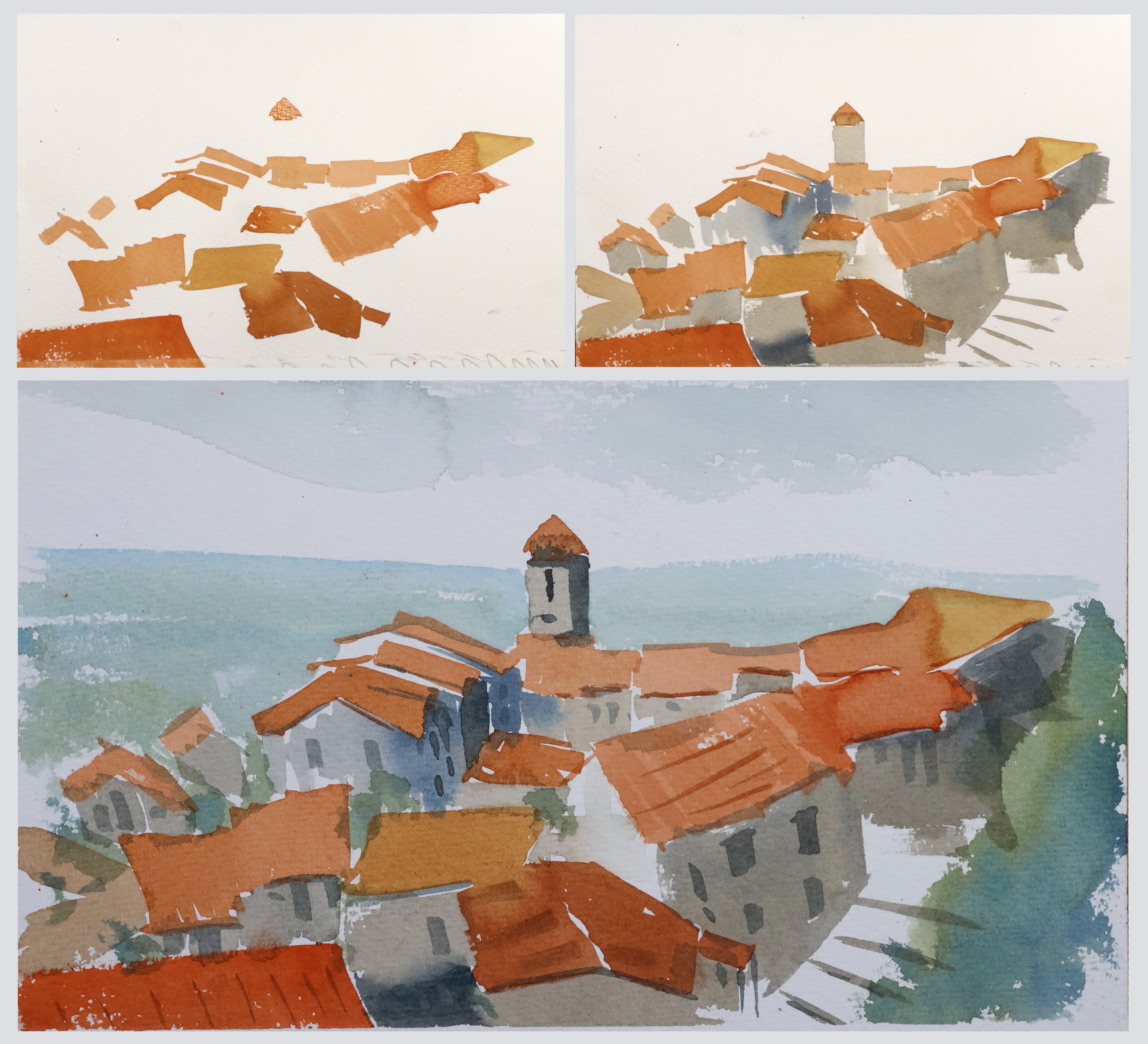
Look at your reference and pick out the big shapes. Notice how the roofs group together rather than sitting apart. That is what we’re painting. We'll work straight in with the brush, no pencil
Use a flat brush to paint an array of rooftops at different angles, some connected, some isolated. Aim for an interesting pattern, not architectural accuracy. Vary the colours across the roofs.
Leave thin gaps of white paper between some of the roofs so they don't merge into one blur.
The church tower is the odd one out, a pointed roof on a column. Let it stand out above the roofs.
Now use a pale grey to paint in the houses, leaving some walls white where the sunlight hits.
Once it’s dry, darken some of the walls, add some windows and shadows
If you want, drop in a soft, pale background behind the town.
Food Market
The attraction here is the contrasting 2 patterns, the round green baskets on the ground, and the conical white hats above it.
This one's busier, so a light pencil sketch to place the main shapes is fine.
Put a medium dark wash at the top for the background cutting around the hats, and figures to leave them white (for now).
With a light wash, paint the baskets and their vegetables as simple shapes, and suggest the figures with just a torso a shape of colour for faces.
Once dry add some shadows under the baskets, a few darker details and strengthen the left figure.
Everything should be loose and free. If you squint at the finished painting you should immediately see a pattern of bright hats and round green baskets.

Why
Reducing a scene to a few arranged shapes forces you to simplify it.
Seeing scenes as patterns opens up far more ideas of what you can paint. Even simple or boring scenes might offer an interesting pattern.
You paint the design instead of chasing the detail
