
Pattern Paintings
Repeat after me
Our brain is a pattern recognition machine. It’s the thing it does best, and it’s doing it right now, whether you asked it to or not.
Look at the veins in a leaf and you’ll see they branch the same way the tree does. Ripples on water repeat. So do bark, feathers, scales, the seeds in a sunflower. One thing happening over and over, with small variations.
Now look up and around you. The print on your clothes, the motif on a plate or cup, the label on a food package. Someone designed those by doing what we’re practising here: repeating the same marks over and over.
Here’s the part that matters for painting. Your eye groups marks by where they are placed before it judges what they look like.
Spacing registers first. Quality comes second, if at all.
Which means repeated leaf strokes, clustered and spaced well, read as foliage. Forty beautiful leaves, evenly spaced, read as tiled floors. The placement is doing the work, not the brushwork.
So this week we’re painting patterns.
It helps with making consistent brush marks, and using limited palette teaches us about colours harmony.
But the real magic happens while you’re doing it: You’ll get into a flow state. No composition to worry about, no likeness to get right. Just one mark, and the next. Sometimes we forget to enjoy painting, because we’re too busy thinking about how the thing will turn out.
Exercise
Repeating Pattern
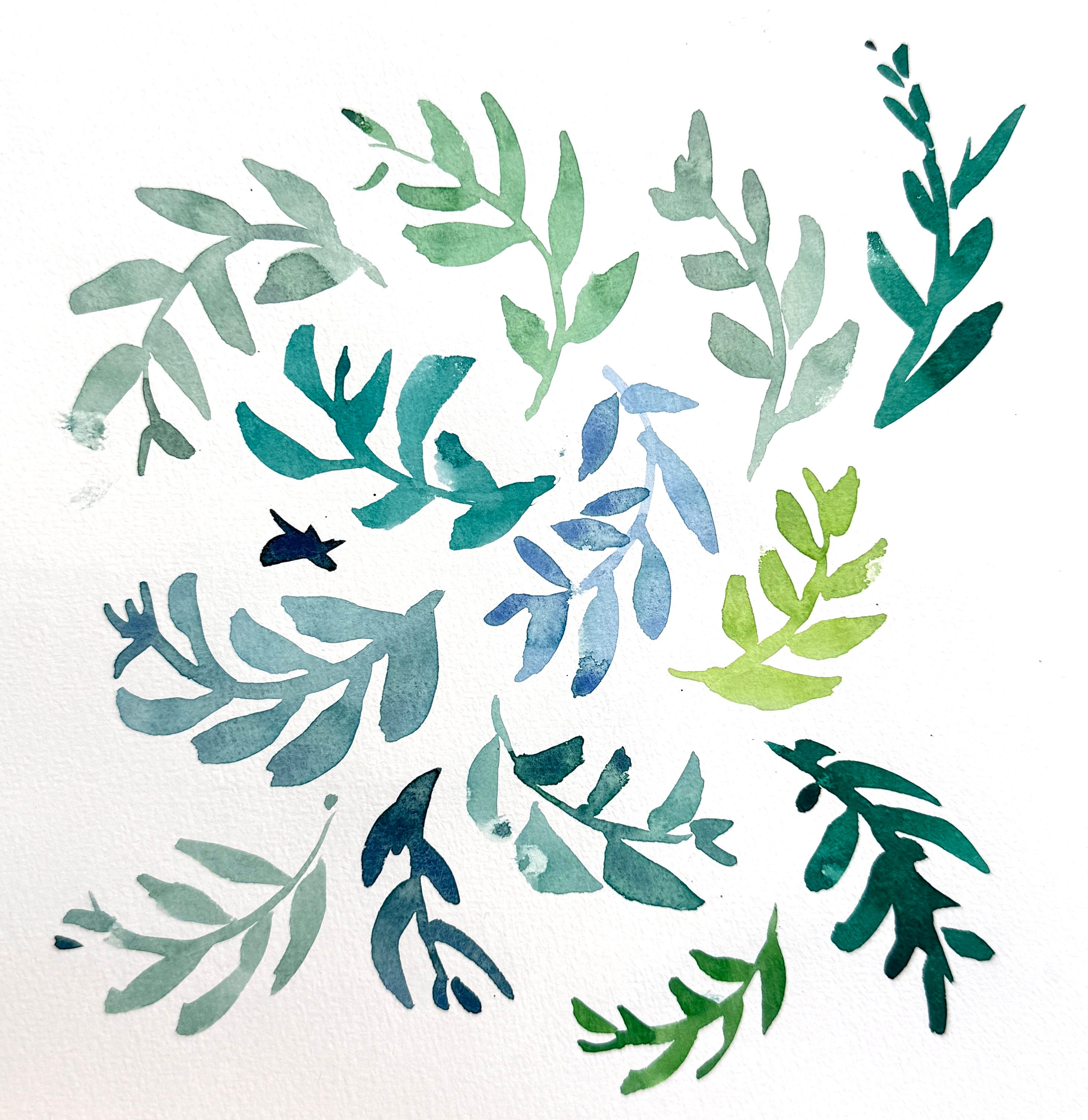
Decide on a simple shape you can repeat. Flowers, leaves, fruit, anything you can paint in a couple of brush strokes. Better still, use a small cluster, a stem with a few leaves off it, rather than a single shape. Repetition is queen here.
Pick three colours at most, like three blues, or colours next to each other on the wheel (yellow, orange, red).
Start anywhere and paint the same motif over and over. Keep the spacing fairly even, but turn each one a different way. That rotation is what stops it becoming a grid.
Pattern in a scene
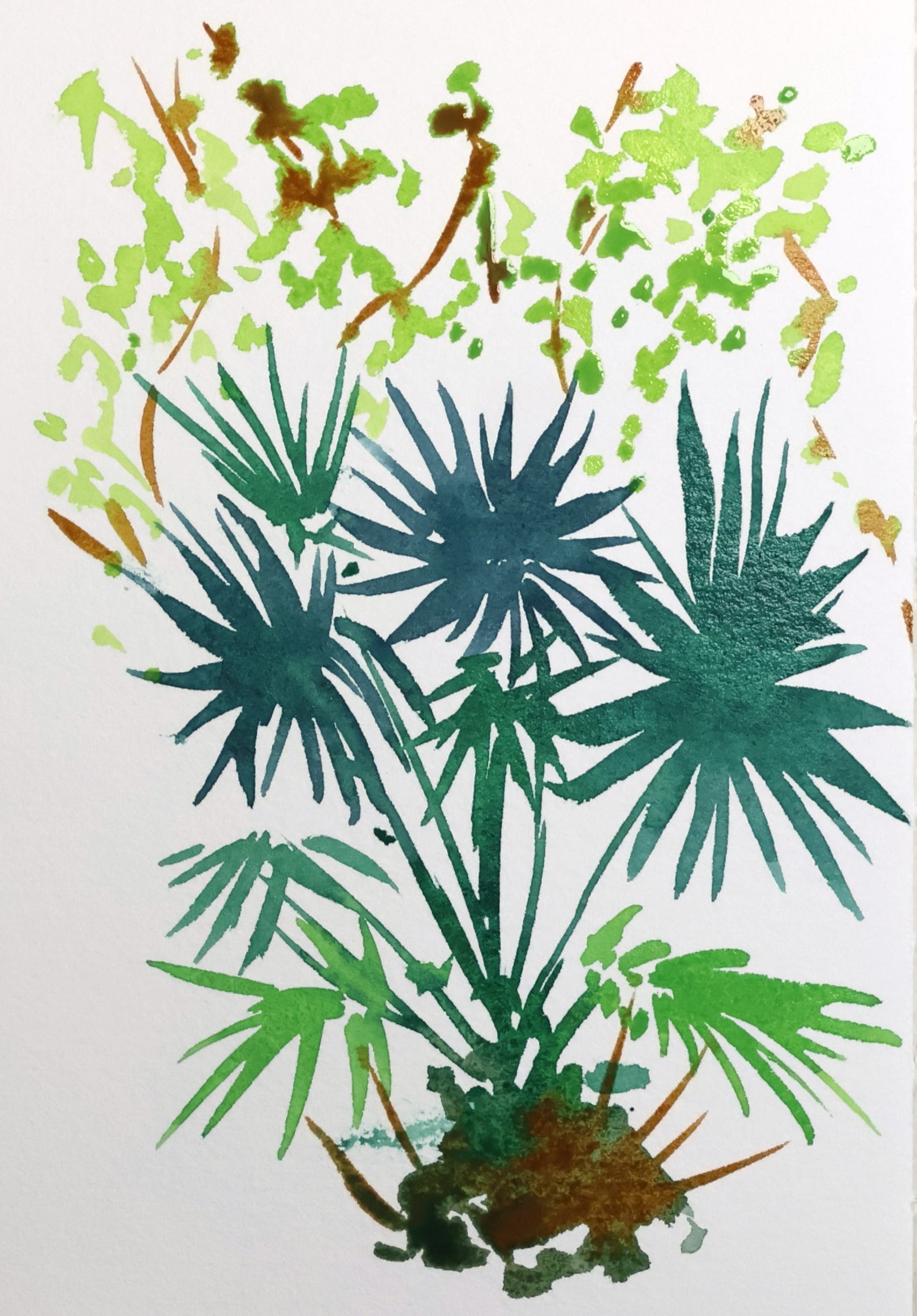
Now that you understand the power of patterns, you can use them in more figurative paintings too. A cluster of trees, an assembly of buildings, a field of flowers, they’re all just patterns.
Choose two patterns and combine them in a scene. Make them different in scale and value. In my example the cabbage tree fans are large, dark and spiky, while the canopy behind is small, light and broken up. That difference is what pushes one forward and lets the other sit back.
It’s a fun way to paint in a more graphic style and capture the rhythm of a scene rather than its likeness.
Why
Repeating one mark is the fastest way to make it consistent and improving brush skills
Once you start looking for patterns you’ll see them everywhere
Painting as a meditative practice
