
Let It Flow
Painting with water, without a brush
Last week, we explored how limiting ourselves to a single brush challenged our traditional painting approach.
Just as restricting ourselves to one brush explored new possibilities in mark-making, let’s discover what happens when we set brushes aside and play with ways to control the flow of water itself.
We'll develop a deeper understanding of how water behaves on paper - knowledge that will enhance your regular brush technique when you return to it.
Sometimes the best way to improve our relationship with a familiar tool is to temporarily let go of it.
Exercise
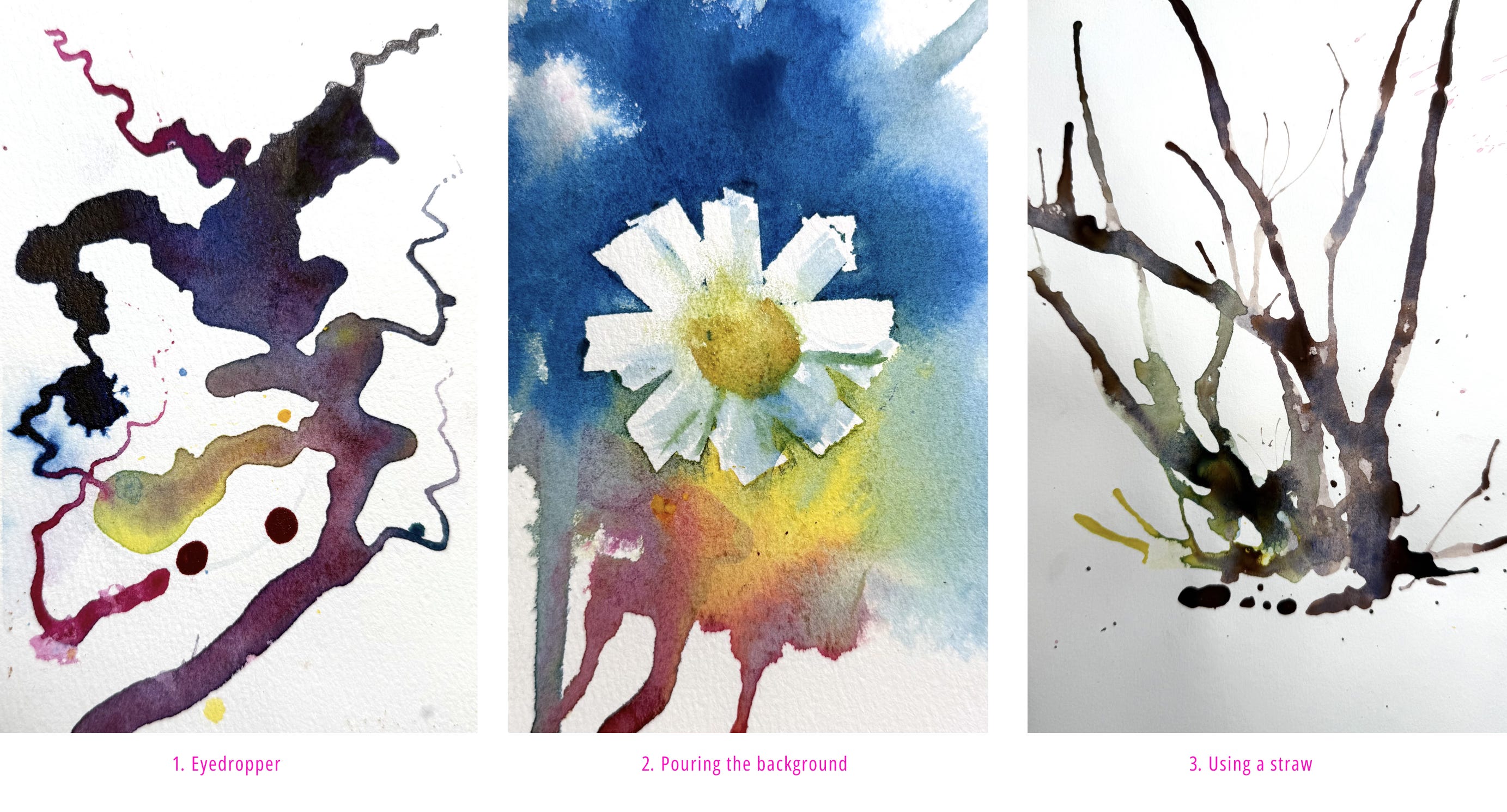
Use an eye dropper, pipette or squeeze a fully loaded brush to drop pigment on paper and create abstract patterns. Experiment with colours and consistencies of mixes. Tilt and swivel the paper to direct the flow.
Wet your paper, then pour colours (from a dish) and flood the page, letting the colours mix on the paper. I use this for soft backgrounds and first washes. Try preserving whites with tape or masking fluid.
Use a straw to blow puddles into different shapes, creating tree like structures and organic shapes.
Examples
As described above I used all 3 techniques:
I placed blobs with an eyedropper, tilted the paper to blend the colours, and then used the tip of the dropper to “draw” the finer lines
I masked the flower with tape, then poured 3 primary colours for the background. Once dry I finished the flower (with a brush 🤫)
Started with blobs from the eyedropper, then used a straw to blow the branches
Premium subscribers can view a video of how I create examples 2 and 3.
Why?
Understanding how water is flows, pools, and dries is what makes watercolour feel effortless instead of frustrating.
By focusing on how water behaves, you’ll:
Learn to predict and embrace blooms and backruns instead of fighting them
Understand the relationship between water and pigment—how timing, tilt, and dampness change everything
Build confidence and intuition for wet-on-wet, soft blends, and moody atmospheric washes
Most of all, this week’s practice helps you let go a little. It's not about precision, it's about exploring, experimenting, and reacting.
Continue reading for:
Video: Demonstrations of 2 examples above
Video: A seascape painting without a brush (almost)
Master Artist references - 2 artists with amazing water control
Advanced Practice Prompt
